
Diamonds
How to tell if a diamond is real: myths and reliable checks
The fog test, the water glass and the newspaper trick are everywhere, but none of them can prove a diamond is real. Here is what home checks can honestly tell you, what a jeweler's tester measures, and how a grading report settles the question.
Published
The short answer
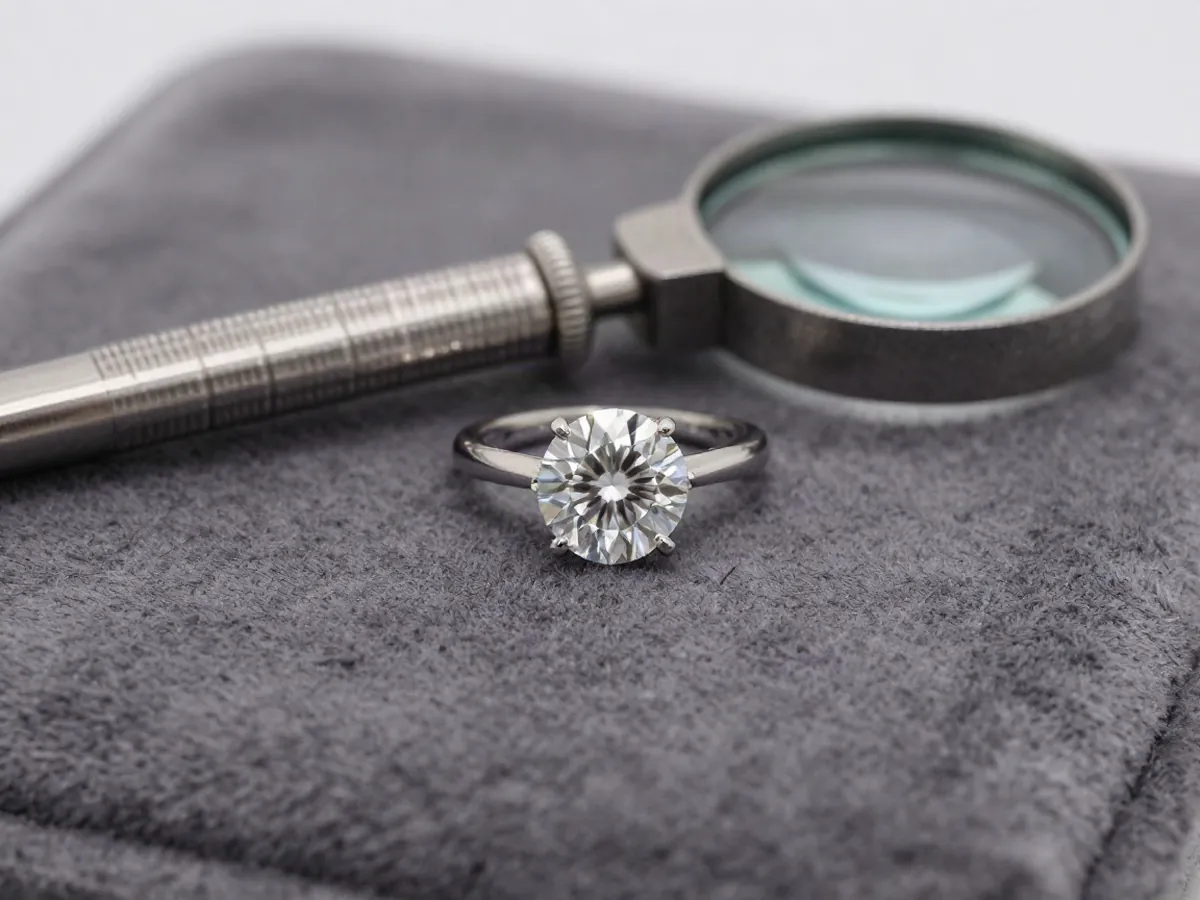
You cannot prove a diamond is real at home. Popular tricks like breathing on the stone, dropping it in water or reading print through it are at best weak clues, and several common imitations pass them. What you can do at home is collect evidence: look through a loupe, read the marks on the setting, check for wear, and note whether there is a laser inscription on the girdle.
For a definite answer you need either a jeweler with a modern diamond tester (one that checks both thermal and electrical conductivity), or a grading report from a recognised laboratory that you can verify online. This guide walks through each step, and is honest about what every step can and cannot show.
What "real" actually means
In the US, the FTC Jewelry Guides define a diamond as a mineral made essentially of pure carbon crystallized in the cubic (isometric) system, with a hardness of 10, a specific gravity of about 3.52 and a refractive index of 2.42. Anything that does not meet that definition cannot be sold as an unqualified "diamond".
That definition matters because people often mean two different questions when they ask whether a diamond is real. The first is: is it diamond at all, or an imitation such as cubic zirconia, moissanite, white sapphire or glass? The second is: is it a natural diamond or a laboratory-grown one? Lab-grown diamonds are real diamond material, so the tests that catch imitations will not flag them. We cover lab-grown stones separately below.
Popular home tests and why they mislead
Most viral tests rely on one property of diamond and ignore the fact that other materials share it, or that a dirty or mounted stone behaves differently. Here is how the usual ones hold up:
- Fog test: diamond disperses heat quickly, so breath fog clears fast. Moissanite also conducts heat well, and an oily film or a cold room changes the result. A clue, not proof.
- Water test: a loose diamond sinks, but so do cubic zirconia, moissanite, sapphire and glass. Almost every gem sinks, so this rules out very little.
- Newspaper or dot test: a well-cut round diamond bends light so strongly that print is hard to read through it. But it only works on loose stones of certain cuts, and many imitations with a high refractive index give a similar result.
- Scratch test: diamond is the hardest natural material, but scratching glass proves little (many stones do) and scratching the diamond itself can chip it along its cleavage planes. Do not do it.
- Toothpaste or sandpaper tests: these can damage soft imitations and do not identify a diamond. They also risk damaging the setting.
- Flashlight and UV tests: some diamonds glow blue under UV light, many do not, and some imitations glow too. Fluorescence alone is not an identification.
Clues you can check at home
None of these is proof on its own, but together they tell you whether a closer look is worth paying for. Clean the stone first with warm water and a drop of mild dish soap, dry it with a lint-free cloth, then work in good daylight.
Look through a 10x loupe. Natural diamonds often contain tiny crystals, feathers or clouds; a stone that is perfectly clean at 10x is not suspicious by itself, but tiny gas bubbles or a rounded, moulded look to the facet edges point to glass. Look at the facet junctions: diamond's hardness keeps edges crisp for decades, while cubic zirconia and glass often show rounded or chipped edges after years of wear.
Look at the colour of the sparkle. Diamond shows a mix of white light and colour flashes. Cubic zirconia's dispersion is higher than diamond's, and moissanite's is far higher, so a stone that throws strong rainbow flashes everywhere deserves a second look. Looking down through the top of moissanite at an angle, you may also see doubled facet edges, because it is doubly refractive; diamond is not.
Check the girdle (the thin outer edge) with the loupe for a laser inscription. Many graded diamonds carry a report number there, which you can look up.
The setting and the metal tell a story too
A real diamond is usually set in precious metal. Look inside the band and on the gallery for marks such as 14K, 585, 18K, 750, PT950 or PLAT. Use the free Hallmark Quick Reference to check what a mark means. A stamp is a clue, not proof, but a large "diamond" in a base-metal or plated setting marked 925, GP or nothing at all is a reason to be cautious.
Look at how the stone is held. Fine jewelry usually uses prongs, bezels or channels; imitation jewelry more often relies on glue. A closed back that hides the underside of a large stone is common in older and costume pieces. A setting marked "C.Z." or "MOISS" tells you directly what the stone is.
What a jeweler's tester actually measures
Diamond is an excellent conductor of heat. Basic thermal testers press a heated tip against the stone and measure how fast the heat is drawn away; diamond pulls heat away quickly, while most imitations, including cubic zirconia and glass, do not. The catch is moissanite, which also conducts heat very well, so older thermal-only probes can read it as diamond.
Most diamond is an electrical insulator while moissanite conducts electricity, so combined testers that check thermal and electrical conductivity can separate the two. Even then, results depend on a clean stone, good contact and a correctly calibrated tool, which is why a jeweler will often confirm a reading with a loupe or a refractometer-type check.
A phone cannot do any of this. Diamond tester apps that ask you to hold the camera over a stone cannot measure heat or electrical conductivity; the most a camera can do is document the cut, colour, inclusions and setting so that a person or an AI can make an informed estimate.
Grading reports and how to verify them
For a stone that matters, by price or by sentiment, a report from a recognised gemological laboratory is the clearest answer. A report states whether the stone is diamond, whether it is natural or laboratory-grown, and grades such as carat weight, colour, clarity and cut.
If you have a GIA report, enter the report number in GIA Report Check. It confirms that the details on your paper match what GIA has archived. Then compare the report with the stone itself: the shape, measurements and carat weight should fit, and if the report mentions a girdle inscription, find it with a loupe. A report that cannot be verified, or a stone that does not match its report, is a reason to get an independent opinion before you buy or sell.
What about lab-grown diamonds?
Laboratory-grown diamonds are chemically and physically diamond, so a standard diamond tester reads them as diamond and no home test can separate them from mined stones. Telling natural from lab-grown requires laboratory screening equipment or a grading report.
If a seller describes a stone as a diamond, ask in writing whether it is natural or laboratory-grown, and look for the answer on the report. If you are evaluating a piece you already own, the honest answer is "diamond, origin unknown" until a lab or a jeweler with screening equipment has checked it.
Common mistakes
A few mistakes turn up again and again when people try to check a diamond themselves:
- Trusting a single test, especially the fog or water test, as a final answer.
- Scratching or heating the stone to test it, which can damage both a diamond and an imitation.
- Testing a dirty stone: grease and lotion change how heat, light and fog behave.
- Assuming a thermal tester reading of "diamond" rules out moissanite.
- Assuming a stone is fake because it fluoresces, or real because it does not.
- Ignoring the setting: the metal and the way the stone is held are part of the evidence.
- Accepting a report number without checking it online and comparing it with the stone.
Where CaratAI fits in
CaratAI is a jewelry identifier app: you photograph a piece and get an estimate of what it may be, including likely materials and points worth checking. It is useful for sorting a drawer of jewelry, deciding which pieces deserve a professional look, and preparing good photos and notes before you visit a jeweler.
It is not a diamond tester and does not replace one. A photo cannot measure conductivity, refractive index or weight, so an app's result is an estimate to guide your next step, not proof. Use it together with the loupe checks above and a jeweler's test or lab report when the answer matters.
Frequently asked questions
Does a real diamond fog up? A diamond clears breath fog quickly, but moissanite does too, and dirt or temperature changes the result. The fog test cannot confirm a diamond.
Can a diamond tester be wrong? A thermal-only tester can mistake moissanite for diamond, and any tester can misread a dirty stone or one held badly. Combined thermal and electrical testers used by a jeweler are more dependable.
Will a jeweler test my diamond for free? Many jewelers will run a quick tester check, but policies vary, so ask first. A full grading report from a laboratory is a paid service.
Is a stone real if it scratches glass? No. Many gems and imitations can scratch glass, so this proves very little and risks damage.
How can I tell if my diamond is lab-grown? Not at home. A lab report or a jeweler with screening equipment can tell natural from lab-grown diamond.
Sources and further reading
- eCFR: 16 CFR 23.12, definition and misuse of the word "diamond" (FTC Jewelry Guides) — Defines diamond as crystallized carbon with hardness 10, specific gravity about 3.52 and refractive index 2.42.
- GIA: Report Check — Confirms that the details on a GIA report match GIA's archived record.
- Wikipedia: Diamond simulant — How thermal probes separate diamond from most imitations, and why older probes can be fooled by moissanite.
- Wikipedia: Cubic zirconia — Cubic zirconia: refractive index 2.15–2.18 vs 2.42 for diamond, density about 1.65 times diamond's, hardness 8–8.5.
Keep exploring
All blog posts
Gold price drop: what it means for the value of your gold jewelry
Spot gold fell below $3,900 an ounce on October 30, 2026, its lowest level in more than a year. Here is how a falling gold price changes the melt value of your rings and chains per gram by karat, what it does and does not do to buyer offers, and how to recalculate your own pieces.
Read article
Gold filled vs gold plated vs vermeil: what the labels mean
Gold filled, gold plated and vermeil all put a layer of gold over another metal, but the amount of gold, the base metal and the marks differ. Here is what each label means under the US FTC Jewelry Guides and how to read GF, RGP, GEP and HGE stamps.
Read article