
Testing gold
How to tell if gold is real: what home checks can and can't show
Marks, magnets and a close look can tell you a lot about a gold piece, but none of them proves it is solid gold. Here is what each check shows, what it misses and when to get a professional test.
Published
The short answer
There is no single home test that proves a piece is real gold. What you can do at home is gather clues: read the marks, check how the piece reacts to a magnet and look closely at the places that wear first. Together, these clues tell you whether a piece is probably gold, probably plated or a question for a professional.
If money depends on the answer, for example before you buy, sell or insure a piece, the reliable step is a test by a jeweler or an assay office. The checks below help you decide whether that step is worth it and what to ask.
Step 1: read the marks
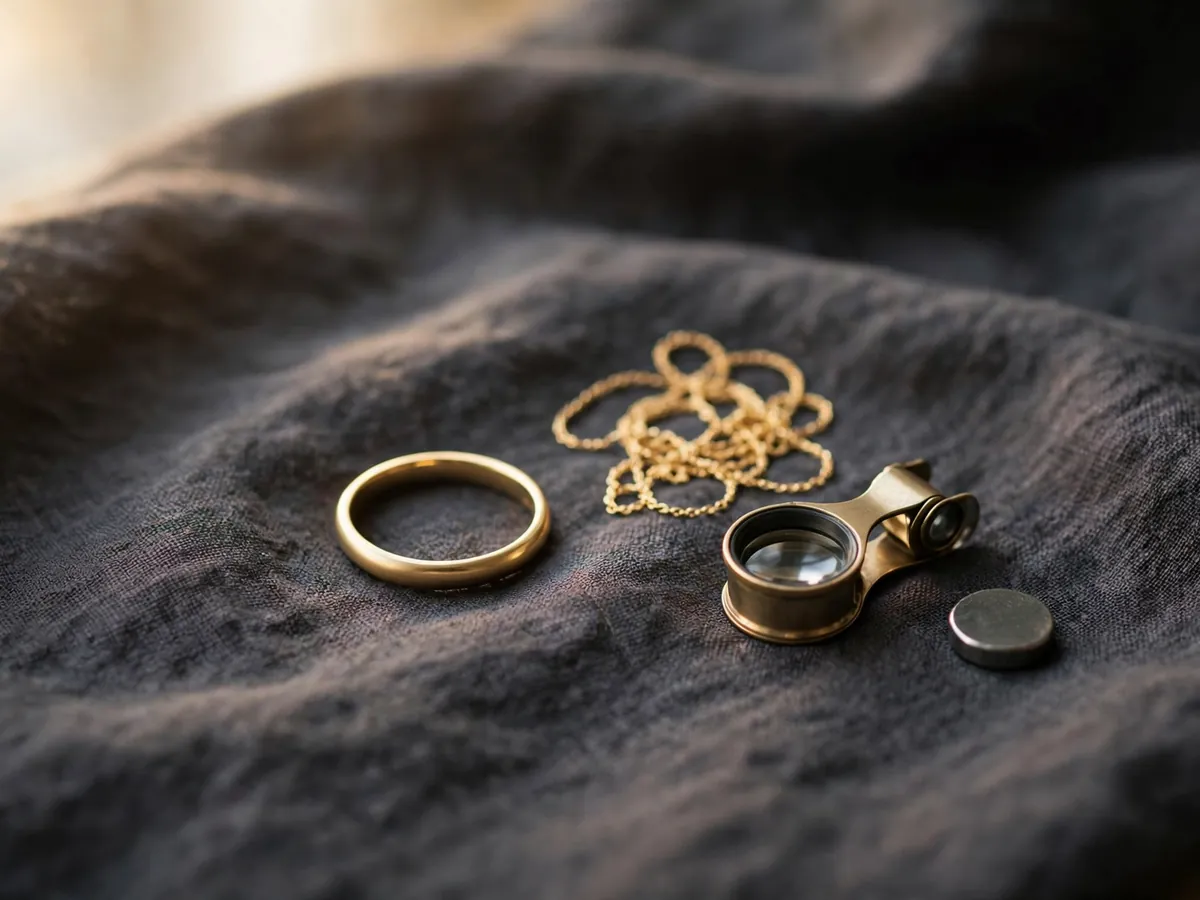
Most gold jewelry carries a small stamp inside a ring band, on a clasp or on a tag near the end of a chain. Use a loupe or your phone camera zoomed in under good light. Karat marks such as 14K or 18K, or fineness numbers in parts per thousand such as 585 or 750, describe how much gold the alloy is meant to contain. Plating marks describe a thin layer of gold over another metal.
In the United States, the Federal Trade Commission’s consumer guidance tells shoppers to look for the maker’s name or registered trademark next to the karat mark. In the UK, a full hallmark is applied by an Assay Office after testing, and GOV.UK lists 1 gram as the weight above which gold sold there must be hallmarked. Common marks you may find:
- 9K or 375, 14K or 585, 18K or 750, 22K or 916: karat gold, from lower to higher gold content.
- 24K or 999: fine gold, which is soft and less common in everyday jewelry.
- GP, GEP or HGE: gold plated or gold electroplated, a thin layer over a base metal.
- GF, RGP or “1/20 14K GF”: gold filled or rolled gold plate, a thicker bonded layer over a base metal.
- 925 on a gold-coloured piece: sterling silver underneath, usually with gold plating on top.
Step 2: simple home checks and their limits
A magnet is the easiest check. Gold is not magnetic, so a strong pull from a small magnet is a warning sign that the piece, or part of it, is a magnetic base metal. A clasp spring can be steel even on a real gold chain, so test the main body of the piece. The limit is just as important: no reaction does not prove gold, because brass, copper and many plated alloys are not magnetic either.
Next, look at the places that rub against skin and clothing: the underside of a ring band, the edges of a clasp, the links of a chain. If a different colour shows through there, such as silver-grey or reddish metal, the gold is likely a surface layer. Avoid the old tricks of biting, scratching or putting acid on a piece you care about; they can damage it and are easy to misread.
A careful density check, and why it is easy to get wrong
Gold is very dense, which is the idea behind the water displacement test. Pure gold has a density of about 19.3 grams per cubic centimetre, and gold alloys are lighter because the other metals are less dense: roughly 13 to 14.5 for 14 karat and roughly 15 to 16 for 18 karat, depending on the mix. Many common base metals, such as brass and copper, are far below those figures.
To try it, you need a scale that reads to 0.01 gram. Weigh the piece dry. Then place a small cup of water on the scale, set it to zero, and hang the piece from a thin thread so it is fully under water without touching the sides or bottom. The new reading in grams is roughly the piece’s volume in cubic centimetres. Divide the dry weight by that reading to get the density.
- Use it only on solid pieces without stones, glue, hollow parts or non-gold clasps.
- Small pieces give unreliable results: a light ring may move the water reading by only a few tenths of a gram, so a scale error of 0.01 gram changes the answer noticeably.
- A result far below the expected range is a strong warning sign; a result inside the range is a clue, not proof.
- Tungsten has almost the same density as gold, so a density check cannot rule out a gold-plated tungsten fake.
Home tests to skip
Some popular tricks do more harm than good, or give answers that are easy to misread. If a piece matters to you, leave these out and use the checks above, then a professional test.
- Biting: it can dent soft gold and tells you nothing reliable about what is underneath.
- Scratching or streaking on unglazed ceramic: it removes metal, leaves a mark, and only tests the surface, which on a plated piece is gold.
- Vinegar or other kitchen liquids: many metals show no visible change in a short soak, so “no reaction” proves nothing.
- Holding a piece in a flame: heat can damage stones, enamel, glue and solder joints.
- Home acid kits on a piece you care about: they are corrosive, need a scratch to test, and are easy to read wrongly without practice.
Two worked examples
An inherited chain: it has a 14K mark next to a maker’s initials, the magnet does not pull it, and the links that rub most still show the same yellow colour all the way through. None of these proves solid gold, but they point in the same direction, so it is likely 14 karat gold. If you plan to sell it or insure it, a jeweler’s test confirms what it is before you rely on a price.
A market bracelet: it is stamped 14K HGE, the magnet does not pull it, and the edges of the clasp show a greyish metal through the yellow surface. Here the mark itself says gold electroplate, and the wear spot agrees. The bracelet is gold-plated base metal, and its value lies in its design rather than in gold content, so there is little reason to pay for a metal test.
Step 3: when to get a professional test
A jeweler can test metal with methods that are more reliable than home checks, such as an electronic gold tester, an acid test on a touchstone or an X-ray fluorescence analyser, which reads the surface composition without cutting the piece. Ask which method they use and whether it could leave a mark. In the UK, the Assay Offices also test and hallmark precious metal items.
Get a professional test when you are about to pay a gold price for an unmarked or worn piece, when you plan to sell to a buyer who pays by weight, or when an inherited piece may be worth insuring. A test tells you what the metal is; for a full value that includes stones, design and maker, ask for an appraisal from an independent qualified professional.
Where a photo estimate fits in
Before you visit a jeweler, a photo can help you organise what you know. Jewelry Identifier — CaratAI looks at a jewelry photo and gives AI-generated observations about the visible type, materials, style and possible gemstones, plus an estimated value range you can save with your own notes, such as the marks you found and the magnet result.
A photo cannot test metal, so treat that result as a starting point, not proof that a piece is gold. Use it to decide which pieces to take for testing and what to ask, and rely on a professional test or appraisal for any decision that depends on what the piece really is.
Frequently asked questions
Does real gold stick to a magnet? No. Gold is not magnetic, so a strong pull is a warning sign. But many fake and plated pieces are not magnetic either, so no reaction does not prove a piece is gold.
Can a piece marked 14K still be fake? Yes. A stamp is easy to strike on any metal. A maker’s mark or registered trademark next to it, an assay office hallmark, wear that shows the same colour underneath and a professional test all make the mark more believable.
What is the most reliable way to test gold? A test by a jeweler or an assay office, for example with an electronic tester, a touchstone acid test or an X-ray fluorescence analyser. Ask which method they use and whether it leaves any mark.
Is it worth testing an inexpensive piece? Usually only if you would pay or receive a gold price for it. If the piece is marked as plated or bought as fashion jewelry, its value is in its design and a metal test is rarely worth the cost.
Sources and further reading
- GOV.UK: Hallmarking practical guidance summary — What a UK hallmark is, its compulsory marks, and the 1 gram minimum weight at which gold must be hallmarked.
Keep exploring
All blog posts
How to tell if a diamond is real: myths and reliable checks
The fog test, the water glass and the newspaper trick are everywhere, but none of them can prove a diamond is real. Here is what home checks can honestly tell you, what a jeweler's tester measures, and how a grading report settles the question.
Read article
Gold price drop: what it means for the value of your gold jewelry
Spot gold fell below $3,900 an ounce on October 30, 2026, its lowest level in more than a year. Here is how a falling gold price changes the melt value of your rings and chains per gram by karat, what it does and does not do to buyer offers, and how to recalculate your own pieces.
Read article