
Gold value
How to calculate the melt value of gold jewelry (per gram by karat)
Melt value is the price of the pure gold inside a piece, and you can work it out yourself with three numbers: the weight in grams, the fineness, and today's gold price. Here is the formula, a karat table, where to read the price, and worked examples you can repeat with your own jewelry.
Published
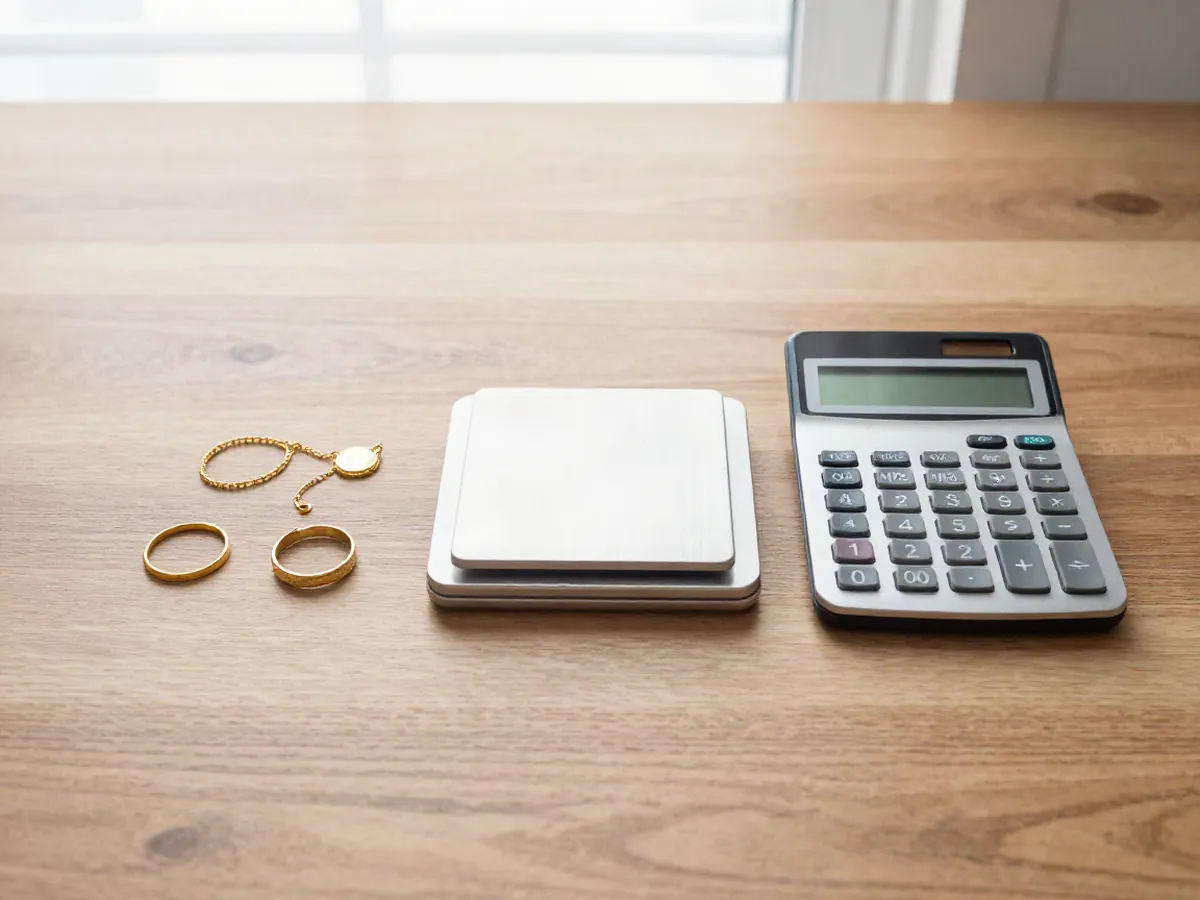
The short answer
Melt value = weight in grams × fineness × price of one gram of pure gold. Fineness is the share of pure gold in the alloy: 0.585 for 14K, 0.750 for 18K, and so on. The price per gram is the spot price per troy ounce divided by 31.1035.
That number is the value of the gold content only. It ignores stones, craftsmanship, brand and condition, and it is not what a buyer will hand you: dealers pay a percentage of melt value to cover refining and their margin. Gold prices also move every trading day, so always check the price on the day you calculate.
The formula, step by step
Every melt calculation, whether done by you, a pawn shop or a refiner, comes down to the same steps:
- Weigh the piece in grams. If a scale shows troy ounces or pennyweights, convert: 1 troy ounce = 31.1035 g, 1 pennyweight (dwt) = 1.5552 g.
- Find the fineness from the stamp: 417 or 10K = 0.417, 585 or 14K = 0.585, 750 or 18K = 0.750.
- Multiply weight by fineness to get the grams of pure gold.
- Look up today's gold price per troy ounce and divide by 31.1035 to get the price per gram of pure gold.
- Multiply the pure-gold grams by the price per gram. That is the melt value.
Fineness by karat
Karats count gold in 24ths; millesimal fineness counts it in thousandths. Jewelry is usually stamped with one or the other, and many countries use the thousandths number as the official hallmark. These are the common values used in a melt calculation: Some older or imported pieces use other numbers, such as 583 for 14K on Soviet-era jewelry or 916 for 22K on South Asian gold, so read the actual number rather than assuming a standard one.
- 9K = 375 = 37.5% gold
- 10K = 417 = 41.7% gold
- 14K = 585 = 58.5% gold
- 18K = 750 = 75.0% gold
- 21K = 875 = 87.5% gold
- 22K = 916 = 91.6% gold
- 24K = 999 = 99.9% gold
Where to read today's gold price
Spot gold is quoted in US dollars per troy ounce and changes all day while markets are open. For a quick figure, free price pages such as Kitco show the current spot price per ounce and often per gram. The LBMA Gold Price, set twice each business day in London, is the benchmark many dealers and contracts refer to; LBMA lists where it is published.
Write down the price, the time and the currency you used. If you think in another currency, either use a price page quoted in that currency or convert the dollar figure with the day's exchange rate. Because the price moves, a melt value is a snapshot of one moment, not a fixed property of your jewelry; recalculate when you are ready to compare offers.
Weigh it properly
Weight is the number you control, so get it right. A small digital jewelry scale that reads to 0.01 g is ideal; a kitchen scale reading to 1 g is too coarse for a ring that weighs 3 g. Zero the scale, place the piece in the centre, and weigh twice. If your scale can switch units, set it to grams before you start, and check it now and then with an object whose published mass you can look up, because inexpensive scales drift as their batteries run down.
Chains and bracelets weigh more than people expect, rings less. Hollow chains and puffed hearts can look heavy but weigh little, which is why weighing beats guessing. If the piece has stones, weigh it anyway and note that the stone weight is included; we come back to that below.
Worked examples
These examples use a round illustrative price of $100 per gram of pure gold so the arithmetic is easy to follow. It is not today's price: replace it with the price you just looked up.
A 14K chain weighing 10.0 g: 10.0 × 0.585 = 5.85 g of pure gold; 5.85 × $100 = $585 melt value.
An 18K ring weighing 4.2 g: 4.2 × 0.750 = 3.15 g of pure gold; 3.15 × $100 = $315.
A 10K class ring weighing 12.5 g: 12.5 × 0.417 = 5.21 g of pure gold; 5.21 × $100 = $521.
To use a real price, take the spot price per troy ounce and divide by 31.1035. If gold were $3,110.35 an ounce, a gram of pure gold would be $100, which is how the round example above was chosen.
Melt value versus what a buyer pays
A buyer who melts your gold has to test it, refine it and resell it, so offers are below melt value. How far below varies a lot between pawn shops, jewelers, mail-in services and refiners, and it can vary by item and by quantity. Knowing the melt value lets you see what share of it an offer represents.
Get more than one quote, ask each buyer what karat and weight they recorded, and compare their figures with yours. If a buyer weighs in pennyweights or a different unit, convert before you compare. A large gap between their weight and yours is worth a polite question. Ask, too, whether the quote is fixed for a set time or depends on the gold price at the moment the item arrives or is tested, because a mail-in quote can change if the market moves while the parcel is in transit.
What a melt calculation leaves out
Melt value is a floor, not a full valuation. It deliberately leaves out several things that can make a piece worth far more than its metal: If a piece is signed, old, or set with sizeable stones, have an independent appraiser or jeweler look at it before you consider selling it for scrap, because once it has been melted that extra value is gone for good.
- Diamonds and gemstones, which are valued separately (and should be removed or deducted before melting).
- Designer, brand or maker value, for example signed pieces from known houses.
- Antique or period value, workmanship and rarity.
- Condition and resale demand for the finished piece.
- Non-gold parts: steel springs in clasps, solder, enamel or other metals that add weight but no gold.
Common mistakes
These are the errors that most often distort a home calculation:
- Using the price for a regular (avoirdupois) ounce of 28.35 g instead of the troy ounce of 31.1035 g.
- Treating 14K as pure gold, or using 14/24 = 0.583 and wondering why the total differs slightly from a 585-based figure.
- Weighing on a coarse kitchen scale.
- Including stone weight as if it were gold.
- Using yesterday's price, or a price in the wrong currency.
- Assuming a stamp guarantees the content: GP, GF or HGE pieces have very little gold, and some marks are simply wrong.
Where CaratAI fits in
Before you can calculate anything, you need to know what the piece probably is. CaratAI helps you photograph a piece and its stamp and get an estimate of the likely metal and fineness, so you know which numbers to put into the calculator and which items deserve a professional test.
The free Gold Melt Value Calculator on this site then does the arithmetic. Both give estimates: neither replaces an acid, XRF or fire assay test, an appraisal, or a buyer's written offer.
Frequently asked questions
How much is 14K gold worth per gram? Multiply the current price per gram of pure gold by 0.585. Because the price changes daily, check it the same day.
Why is the buyer's offer lower than my melt value? Buyers pay below melt to cover testing, refining and their margin. Compare several written quotes.
Do I use troy ounces or regular ounces? Troy ounces. Gold is quoted per troy ounce of 31.1035 g.
Does white gold or rose gold change the calculation? No. The colour comes from the other metals; 14K white, yellow and rose gold all contain 58.5% gold.
Can I calculate melt value for plated jewelry? Not meaningfully. Gold plated pieces contain only a thin layer of gold, so their melt value is close to zero.
Sources and further reading
- Wikipedia: Troy weight — The troy ounce of 31.1034768 grams and the pennyweight of 1.55517384 grams used for precious metals.
- Wikipedia: Fineness — Millesimal fineness (parts per thousand) and how it relates to karats.
- LBMA: Precious metal prices — Where the LBMA Gold Price, the international benchmark in US dollars per troy ounce, is published.
- Kitco: Gold price charts — A free page showing the live spot gold price per ounce and per gram.
- GOV.UK: Hallmarking practical guidance summary — How fineness marks such as 375, 585, 750 and 916 work in the UK hallmarking system.
Keep exploring
All blog posts
How to tell if a diamond is real: myths and reliable checks
The fog test, the water glass and the newspaper trick are everywhere, but none of them can prove a diamond is real. Here is what home checks can honestly tell you, what a jeweler's tester measures, and how a grading report settles the question.
Read article
Gold price drop: what it means for the value of your gold jewelry
Spot gold fell below $3,900 an ounce on October 30, 2026, its lowest level in more than a year. Here is how a falling gold price changes the melt value of your rings and chains per gram by karat, what it does and does not do to buyer offers, and how to recalculate your own pieces.
Read article