
How to tell if a diamond is lab-grown
How to tell if a diamond is lab-grown: what you can check and what needs a lab
A lab-grown diamond is real diamond, so it passes a diamond tester and looks the same under a loupe. You can still learn a lot at home from the paperwork and the girdle inscription. Here is what to check yourself, how to verify a report, and when only a gem lab can give the answer.
Published
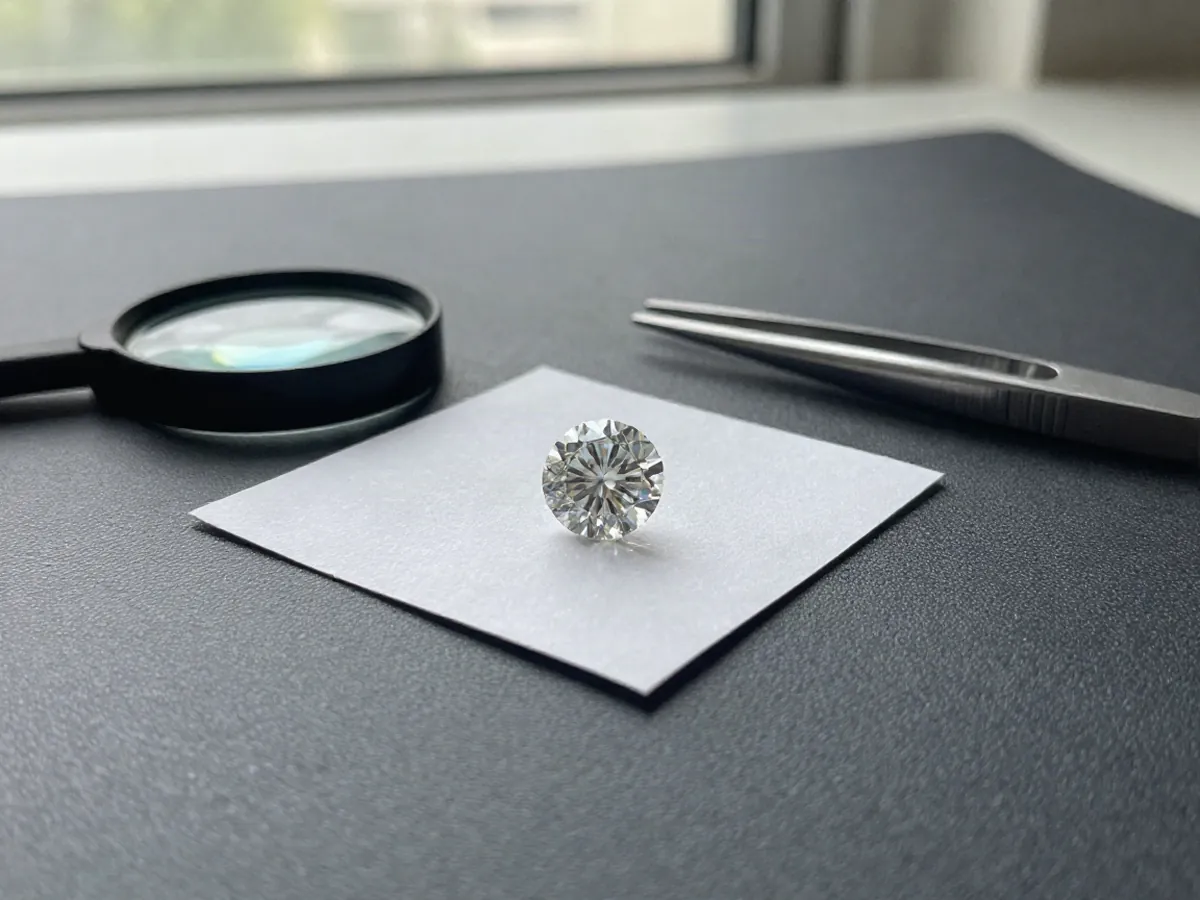
The short answer
In most cases you cannot tell whether a diamond is lab-grown just by looking at it, and a home diamond tester will not tell you either. A lab-grown diamond is diamond, with the same chemistry and optics as a mined one, so it passes the same thermal test and looks the same under a loupe. GIA says plainly that traditional gemological observations and instruments are not able to tell them apart, and that the way to confirm origin is to send the stone to a gemological laboratory.
What you can do at home is gather evidence. Read the receipt and any grading report, look for a laser inscription on the girdle with a 10x loupe, and look up the report number on the issuing lab's own website. Those checks often settle the question for a stone that came with documents. When they do not, or when the stakes are high, a lab test is the answer.
Why it is hard to tell
Lab-grown diamonds are made by two main methods, high pressure and high temperature (HPHT) and chemical vapor deposition (CVD). Both produce crystals of carbon with the same hardness, refractive index and density as natural diamond. They are cut by the same cutters on the same equipment, and they come in the same range of color and clarity grades. That is why the usual tricks for spotting fakes, such as fogging, reading print through the stone or checking for doubled facets, do not apply here: those tests separate diamond from imitations like cubic zirconia or moissanite, and a lab-grown diamond is not an imitation.
The differences that do exist are subtle and microscopic: trace elements such as nitrogen and boron, the pattern in which the crystal grew, and how the stone responds to ultraviolet light and lasers. Reading them takes laboratory instruments built for the job. A jeweler with a loupe may notice a hint, but a hint is not an identification.
Start with the paperwork
The most useful information is usually on paper. Look at the receipt, invoice or listing first. In the United States, the FTC Jewelry Guides require a lab-grown diamond to be clearly described as laboratory-grown, laboratory-created or similar, so honest paperwork should say so. Words such as created, grown, man-made or cultured next to the word diamond all point to a lab-grown stone; words such as natural or mined point the other way.
Next, look for a grading report. Major laboratories grade both kinds of diamonds and state the origin on the report. A report for a lab-grown diamond will say so prominently, usually in the title or at the top. Keep in mind that a document from the seller or manufacturer is not the same as an independent laboratory report, so read who issued it. If there is no paperwork at all, that proves nothing either way, but it means the next checks matter more.
Find the girdle inscription
Many graded diamonds carry a tiny laser inscription on the girdle, the thin band around the widest part of the stone. GIA explains that its inscriptions are not visible to the naked eye but can be seen at 10x magnification. GIA inscribes the report number on every lab-grown diamond it assesses, and other large labs that grade lab-grown diamonds commonly inscribe a report number along with a note that the stone is lab-grown.
To find it, clean the stone first, because skin oil hides fine marks. Hold the ring or the loose stone under a bright, diffused light, bring a 10x loupe close to your eye and then move the stone toward the loupe until the girdle is in focus. Rotate slowly; the inscription is short and may be partly hidden by a prong. Write down exactly what you see. An inscription that says lab-grown settles the origin for practical purposes. A bare number is a lead to follow, not a conclusion.
Check the report against the lab
A report number is only as good as the record behind it. Look the number up on the issuing laboratory's own website rather than trusting a printed copy or a screenshot from the seller. GIA's Report Check, for example, lets you confirm that a GIA report matches the information GIA has on file.
When you have the record in front of you, compare it with the stone. Shape and cutting style, measurements and carat weight should all match, and so should any inscription. A report that describes a natural diamond with quite different measurements from the stone in your hand is a warning sign. If you cannot weigh or measure the stone yourself, a jeweler can do it in a few minutes.
Watch for counterfeit inscriptions
An inscription is strong evidence, but it can be faked. On January 9, 2024, GIA announced that it had seen lab-grown or treated diamonds cut to nearly match GIA-graded natural diamonds and inscribed with the report number of the natural stone. In those cases, looking up the number would have returned a genuine report for a different, natural diamond.
This is rare in everyday buying, but it is why the report check is not only about whether the number exists. The measurements and weight must match too, and for a valuable stone it is worth having the lab or an independent gemologist confirm that the stone in front of you is the one described. GIA said it would offer a same-day service to verify that a diamond bearing a GIA inscription matches the inscribed report.
What home tests can and cannot do
A thermal diamond tester answers one question: is this diamond, or is it something else like glass or cubic zirconia? Lab-grown diamonds conduct heat like natural ones, so they pass. Electrical testers aimed at moissanite are also not built to separate lab-grown from natural, and some lab-grown diamonds can give confusing electrical readings because certain blue diamonds, natural or grown, conduct electricity. In short, a pass on a diamond tester tells you the stone is diamond, not where it came from.
A loupe can show inclusions, but both kinds of diamonds can be clean or included, and clarity grade is not an origin test. Some HPHT stones contain metallic inclusions from the growth process and some CVD stones show layered growth, but these are subtle and easy to misread. Ultraviolet flashlights sold online cannot reproduce what lab instruments do, so treat any result from one as a curiosity rather than an answer.
How gem labs screen diamonds
Gem labs use a chain of instruments. GIA's Gems & Gemology describes how, after weighing and measuring, a stone presumed to be diamond goes through an infrared screening device that detects the presence or absence of nitrogen. Most natural diamonds contain nitrogen and pass; diamonds with little or no nitrogen, which include rare natural stones and most lab-grown ones, are referred for further testing.
Referred stones are examined by specialists using photoluminescence spectroscopy, which reads the fluorescence a stone gives off under laser light and can reliably determine natural or lab-grown origin, and they may be imaged in a DiamondView instrument, where short-wave ultraviolet light reveals growth structures that differ between natural growth and HPHT or CVD growth. GIA also makes desktop screening devices for the trade. Some jewelers and buyers have screening equipment of their own, but a full lab report remains the strongest proof.
Mounted stones and small diamonds
Mounted diamonds are harder to check. Prongs and bezels can cover the girdle, the metal can block instruments, and a lab may be able to screen a set stone but give a fuller result if it is removed. If you are buying, ask for the report before the stone is set, or ask the seller to confirm the origin of a mounted stone in writing.
The small stones around a center stone or along a band, called melee, are rarely tested one by one. Undisclosed lab-grown melee mixed into parcels of natural stones has been reported for years, which is why trade screening of small diamonds exists. If it matters to you that every stone in a piece is natural, or that every stone is lab-grown, ask for that on the invoice.
Where CaratAI fits
CaratAI can help you organize the evidence. Photograph the stone face-up and from the side, the girdle area if you can get a sharp close-up, the marks inside the band and any report or receipt, and the app suggests what the piece probably is and what to do next, such as which lab to look up, what the inscription should say, or what to ask the seller.
The free Hallmark Quick Reference on this site explains metal marks such as 14K, 585, 750 and PT950, so you can identify the setting while you sort out the stone. These are hints and estimates, not a gem lab identification. Whether a diamond was mined or grown can only be confirmed by a gemological laboratory.
FAQ
Can a diamond tester tell if a diamond is lab-grown? No. Home thermal testers identify diamond, and lab-grown diamonds pass.
Can a jeweler tell by looking? Not reliably. A jeweler may notice clues, but confirmation needs lab instruments or a verified report.
Does every lab-grown diamond have an inscription? No. Many graded lab-grown diamonds do, but ungraded stones and older pieces often have none.
Is a lab-grown diamond fake? No. It is real diamond made in a factory rather than mined. The issue is disclosure, not authenticity.
What should I do if the paperwork is missing? Ask the seller to confirm the origin in writing, and for a valuable stone, send it to a gemological laboratory before you pay or insure it.
Sources and further reading
- GIA: How do I identify laboratory-grown diamonds? — GIA's answer on why ordinary gemological observation cannot separate lab-grown from natural diamonds, and why a lab test is needed.
- GIA: What is a laser inscription and is it important? — How GIA inscribes report numbers on the girdle, invisible to the naked eye but readable at 10x.
- GIA: Report Check — Look up a GIA report number to confirm the report matches GIA's records.
- GIA: GIA to Offer Same-Day Report Verification — GIA's January 9, 2024 announcement about counterfeit GIA inscriptions on lab-grown and treated diamonds.
- Gems & Gemology: Analysis of Gemstones at GIA Laboratories — How GIA screens diamonds with infrared, photoluminescence spectroscopy and DiamondView imaging.
- eCFR: 16 CFR 23.12, definition and misuse of the word diamond (FTC Jewelry Guides) — The US rule that a lab-grown diamond must be clearly described as laboratory-grown, laboratory-created or similar.
- Wikipedia: Synthetic diamond — Background on HPHT and CVD growth, the properties lab-grown diamonds share with mined ones, and how labs tell them apart.
Keep exploring
All blog posts
Moissanite vs diamond: how they differ and how to tell
Moissanite is one of the most convincing diamond look-alikes, and some simple diamond testers cannot tell the two apart. Here is what moissanite is, how it differs from diamond in sparkle, hardness and weight, how to spot doubled facets with a loupe, and which tests actually settle it.
Read article
Jewelry stamps and markings: a chart for gold, silver and platinum
The tiny letters and numbers inside a ring or on a clasp tell you what the metal is supposed to be. This chart puts the common gold, silver, platinum and plating marks in one place, explains maker and hallmark stamps, and shows why a mark is a clue rather than proof.
Read article