
Moissanite vs diamond
Moissanite vs diamond: how they differ and how to tell
Moissanite is one of the most convincing diamond look-alikes, and some simple diamond testers cannot tell the two apart. Here is what moissanite is, how it differs from diamond in sparkle, hardness and weight, how to spot doubled facets with a loupe, and which tests actually settle it.
Published
The short answer
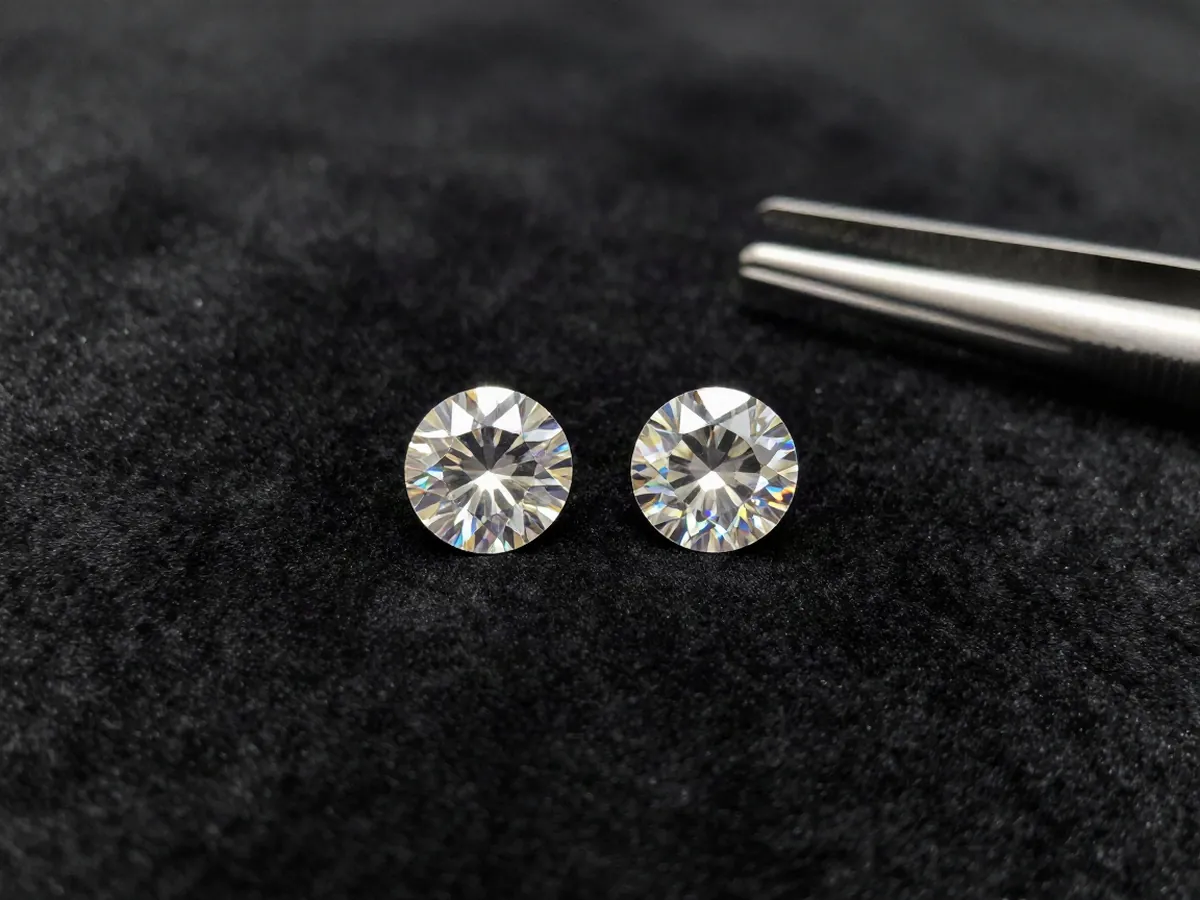
Moissanite and diamond can look very similar in a ring, but they are different materials. Diamond is crystallized carbon; moissanite is silicon carbide, almost all of it made in a laboratory. Moissanite usually shows more colorful flashes, or fire, than diamond, it is slightly less hard, it is lighter for its size, and above all it is doubly refractive, which makes facet edges look doubled under magnification. Diamond is singly refractive and never shows that doubling.
The catch is that moissanite conducts heat much like diamond, so older thermal diamond testers can call it a diamond. If you need a firm answer, use a tester that also measures electrical conductivity, look for doubling with a loupe, check any grading report, or ask a jeweler or gem lab. None of this makes moissanite a bad stone; it only matters that it is sold and bought as what it is.
What moissanite and diamond are
Natural moissanite was discovered by the French chemist Henri Moissan in 1893 in rock samples from Meteor Crater in Arizona; he first thought the crystals were diamonds. Natural moissanite is extremely rare, so the moissanite in jewelry is lab-grown silicon carbide. It was introduced to the jewelry market as a diamond alternative in 1998, and the original patents on the process have since expired, so many companies now produce it.
Diamond is pure carbon crystallized in the cubic system. It can be natural or laboratory-grown; a lab-grown diamond is still diamond, with the same chemistry and physical properties. Moissanite is neither: it is a separate material that imitates diamond, which is why it is called a diamond simulant. US jewelry guides say that the word diamond should be used only for diamond, with lab-grown diamonds clearly qualified, so an honest seller will always describe moissanite as moissanite.
Side by side
The differences that matter most for identification are physical and optical. These are the main ones, in plain terms:
- Material: diamond is carbon; moissanite is silicon carbide.
- Hardness: diamond is 10 on the Mohs scale; moissanite is a little lower, at about 9 to 9.5, harder than almost any other gem.
- Refraction: diamond is singly refractive; moissanite is strongly doubly refractive, so facets can appear doubled.
- Fire: moissanite has more than twice the dispersion of diamond, so it often shows stronger rainbow flashes.
- Weight: moissanite is less dense than diamond, so a moissanite of the same size weighs less.
- Testing: both conduct heat well, but moissanite conducts electricity much better than diamond does.
Sparkle and fire
The most common first impression is that moissanite looks more colorful. Its refractive index is higher than diamond's and its dispersion is much higher, so it splits light into spectral colors more strongly. In daylight or under spotlights a moissanite can throw bold rainbow flashes, especially in larger stones, while a well-cut diamond tends to mix bright white sparkle with smaller flashes of color.
That difference is a hint, not a test. Cut, size, lighting and cleanliness all change how a stone looks, and a dirty diamond can look dull while a small moissanite can look quite restrained. Compare stones side by side under the same light if you can, and treat a strong rainbow look as a reason to check further rather than as proof. Clean the stone with warm water, mild soap and a soft brush before you judge its sparkle, because skin oil and lotion dull every gem.
Doubled facets: the loupe test
Because moissanite is doubly refractive, light entering it splits into two rays. Under a 10x loupe this shows up as doubled facet junctions, the lines where facets meet, which look like two close parallel lines instead of one. Cutters orient moissanite so that the effect is hidden when you look straight down through the table, so look through the side of the stone, through the crown facets at a slight angle, rather than straight from the top.
Inclusions can show the same doubling. Many moissanites contain fine, white, needle-like growth tubes running roughly at right angles to the table, and under magnification these needles also appear doubled. Diamond never shows doubled facets, because it is singly refractive, so clear doubling is a strong sign that a stone is not a diamond. It takes a little practice, so if you are unsure, compare with a stone you know is a diamond.
Color, clarity and weight
Modern moissanite is sold in colorless grades, but some moissanite, especially older production, shows a faint brownish, greenish or greyish tint, which can be easier to see in larger stones and from the side. Diamonds also come in a range of colors, so tint on its own does not identify either stone, but a stone that looks perfectly clean yet slightly tinted and very fiery is worth a closer look.
Weight is a useful clue for loose stones. Moissanite has a specific gravity of about 3.2, while diamond's is about 3.5, so a loose moissanite is noticeably lighter than a diamond of the same size and shape. That is why moissanite is often sold by its millimeter size or by a diamond-equivalent weight rather than by its own carat weight. If a seller gives a size in millimeters but not a weight, ask for both.
What testers can and cannot tell you
A basic diamond tester measures thermal conductivity: how quickly the stone draws heat away from a heated tip. Diamond is an excellent conductor of heat and most simulants, such as glass and cubic zirconia, are not, so the tester separates them in a few seconds. Moissanite is the exception. Its thermal conductivity is similar to diamond's, so an older thermal-only tester can read a moissanite as a diamond.
Moissanite conducts electricity far better than diamond, so multi-testers that check both heat and electrical conductivity can flag it. Diamond is usually an electrical insulator, though a few rare diamonds are not, which is one reason a professional does not rely on a single reading. Gem labs use magnification, refractive and spectroscopic instruments to confirm what a stone is. If a reading matters, for a purchase, an insurance claim or an inheritance, have a jeweler or lab test it rather than relying on a home tester.
Labels, laser inscriptions and reports
Paperwork is often the quickest route to an answer. Diamonds sold with a grading report from a major lab usually have the report number laser-inscribed on the girdle, the thin outer edge of the stone, and you can look up that number on the lab's site; GIA's Report Check, for example, confirms that a report matches its records. A lab report also states whether a diamond is natural or laboratory-grown.
Moissanite is often sold with its own certificate from the producer, and some is inscribed too. A certificate from a seller is not the same as an independent grading report, so read who issued it. If a stone sold as a diamond has no report, no inscription and doubled facets under a loupe, it is time for a professional test before any money changes hands.
Which one should you choose?
This guide is mostly about telling the two apart, but people often compare them when choosing a ring. Moissanite usually costs far less than a diamond of similar size and is hard enough for everyday wear, and some buyers love its extra fire. Diamond is harder, shows a different, whiter sparkle and has a long tradition as an engagement stone. Neither is the wrong choice, as long as you know what you are buying.
Prices for both moissanite and diamonds vary widely and change over time, so compare current listings from several sellers rather than relying on a rule of thumb. For diamonds, compare stones with independent grading reports so you are comparing like with like, and for moissanite ask about color grade, size in millimeters and any warranty. In both cases, keep the paperwork.
Where CaratAI fits
CaratAI can help with a first look. Take clear photos of the stone from the top and side and of the marks inside the band, and the app suggests what the stone and metal are likely to be and what to check next, such as looking for doubling or asking for an electrical-conductivity test.
The free Hallmark Quick Reference on this site explains metal marks such as 925, 14K and 585, which helps because moissanite is often set in silver or lower-karat gold, while fine diamonds are usually set in karat gold or platinum. These are clues and estimates, not a gem lab identification.
Frequently asked questions
Can a diamond tester detect moissanite? Older thermal-only testers often cannot. Testers that also measure electrical conductivity usually can, with rare exceptions.
Is moissanite a fake diamond? It is a different gem that imitates diamond. It is only a fake if it is sold as a diamond.
Is moissanite a lab-grown diamond? No. Lab-grown diamond is real diamond made in a lab; moissanite is silicon carbide.
How can I tell at home? Look through the side of the stone with a 10x loupe for doubled facet lines, and compare the fire with a known diamond.
Will moissanite scratch or get cloudy? It is very hard and durable for everyday wear, though like any stone it can collect grime and needs regular cleaning.
Sources and further reading
- Wikipedia: Moissanite — Silicon carbide's discovery, its use as a diamond alternative since 1998, its hardness, birefringence and why thermal testers can confuse it with diamond.
- Wikipedia: Diamond simulant — How moissanite compares with diamond and cubic zirconia, including refractive index, specific gravity, doubled facets and typical inclusions.
- eCFR: 16 CFR 23.12, definition and misuse of the word diamond (FTC Jewelry Guides) — The US definition of a diamond and the rules for describing lab-grown diamonds and imitations.
- GIA: Report Check — Confirms that the details on a GIA diamond grading report match GIA's archived record.
Keep exploring
All blog posts
Jewelry stamps and markings: a chart for gold, silver and platinum
The tiny letters and numbers inside a ring or on a clasp tell you what the metal is supposed to be. This chart puts the common gold, silver, platinum and plating marks in one place, explains maker and hallmark stamps, and shows why a mark is a clue rather than proof.
Read article
Is my jewelry worth anything? How to sort what you have
Most jewelry boxes hold a mix of fine pieces, plated fashion jewelry and the odd surprise. Here is a calm way to sort what you have: read the marks, check the metal, think about stones, makers and condition, and work out which pieces deserve a professional look.
Read article