
Lab-grown vs natural diamond
Lab-grown vs natural diamonds: what is different and what the label must say
A lab-grown diamond is real diamond, made in a factory instead of found in a mine. The two look the same, test the same at home and wear the same, so the difference lives in the paperwork. Here is how each is made, what sellers must disclose, which words to watch and how to check a report.
Published
The short answer
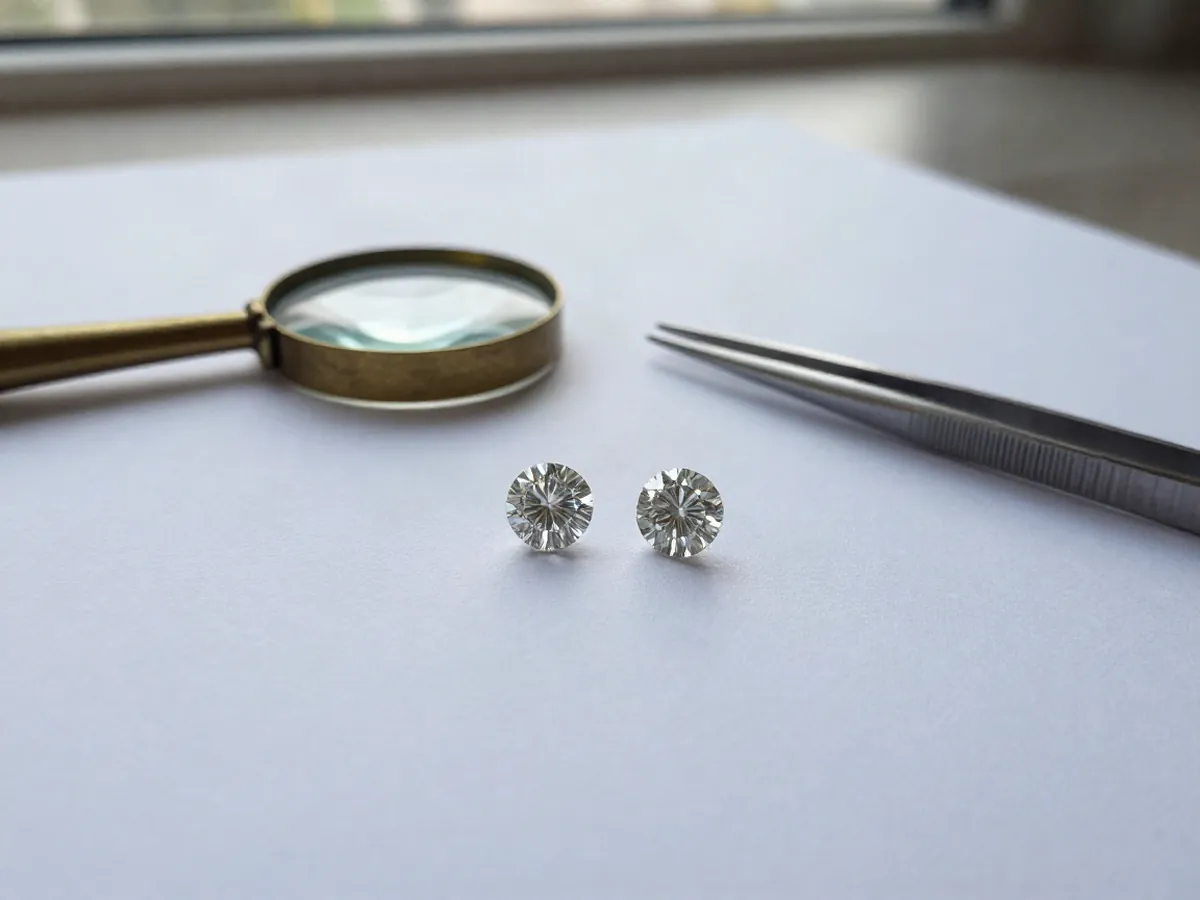
A lab-grown diamond and a natural diamond are both diamond: crystallized carbon with the same hardness, the same sparkle and the same chemistry. The difference is origin. A natural diamond formed deep in the earth and was mined; a lab-grown diamond was grown in a press or a reactor in weeks rather than over geological time. That makes lab-grown diamonds something quite different from imitations such as cubic zirconia or moissanite, which only look like diamond.
Because the two are physically the same material, you cannot tell them apart by eye, with a loupe or with a home diamond tester. What separates them is disclosure and documentation. In the US, the FTC Jewelry Guides say a lab-grown diamond has to be described clearly as laboratory-grown, laboratory-created or with similar words. So the most useful habit is simple: read the label, read the receipt and read the grading report before you pay.
What each one is
A natural diamond, also called a mined diamond, is carbon that crystallized under great heat and pressure in the earth’s mantle and was carried toward the surface long ago. Every natural diamond is the product of conditions nobody controlled, which is why no two have exactly the same inclusions, color or growth pattern.
A lab-grown diamond, also sold as laboratory-created, laboratory-grown or, with a qualifier, cultured, is made in a controlled technological process. It is not a coating or a composite; it is a single diamond crystal, cut and polished like any other. The US definition of a diamond describes a mineral of essentially pure carbon crystallized in the isometric system, with a hardness of 10 and a refractive index of 2.42, and a well-made lab-grown diamond meets that description. What it cannot be called is a mined stone, or a diamond with no qualifier at all.
How lab diamonds are made
Gem-quality lab diamonds are grown in two main ways. The older method, high pressure and high temperature, or HPHT, copies the conditions in which natural diamonds form: a small diamond seed sits in a large press with a metal solvent and a carbon source, and heat and pressure make carbon crystallize on the seed. The newer method, chemical vapor deposition, or CVD, works at low pressure: a gas mixture, usually methane and hydrogen, is energized into a plasma inside a chamber, and carbon atoms settle onto a diamond plate layer by layer.
Both methods can produce colorless stones and colored ones; nitrogen tends to make yellow diamonds and boron blue ones, and some colors are produced by treating the stone after growth. Both kinds of rough are then cut by the same cutters, on the same equipment and in the same shapes as mined diamonds. That is why, once set in a ring, nothing about the shape, polish or sparkle tells you which kind you are looking at.
What is the same and what is not
For everyday purposes the two behave identically. They have the same Mohs hardness, so both resist scratches equally well. They have the same refractive index and dispersion, so a lab-grown and a natural diamond of the same cut and quality sparkle the same way. They respond the same to cleaning, heat and normal wear, and both pass a thermal diamond tester, because both conduct heat like diamond.
The differences are tiny and show up only in a laboratory. Growth in a press or a reactor leaves different trace elements, growth patterns and fluorescence reactions than growth in the earth. HPHT stones can contain small metallic inclusions from the solvent, and CVD stones can show layered growth or traces of silicon. Gem labs read these signs with spectroscopy and ultraviolet imaging instruments built for the purpose. None of them is visible to a buyer in a shop, and none of them changes how the stone looks or wears.
What the label must say
In the US, the FTC’s Guides for the Jewelry, Precious Metals, and Pewter Industries set out how diamonds may be described. Using the unqualified word diamond for something that is not a diamond is deceptive, and a lab-created stone has to carry a qualifier such as laboratory-grown, laboratory-created or the manufacturer’s name followed by created, shown as clearly as the stone’s name itself. The word cultured may be used for a lab diamond only if it comes with a clear and conspicuous disclosure that the stone was not mined.
The same guides say that faux is not an adequate disclosure for a laboratory-created stone. Other countries have their own trade description rules, so the exact wording on a tag can differ, but the principle is the same almost everywhere: a buyer should be able to see, without hunting for it, whether a diamond was mined or made. If a listing or a shop tag only says diamond and you need to know, ask directly and ask for the answer on the receipt.
Words to watch
A few labels cause most of the confusion. Lab-grown, lab-created, laboratory-grown and man-made all mean the same thing: a real diamond that was not mined. Cultured diamond is allowed in the US only with one of those qualifiers next to it. Synthetic is an older word for the same thing; it is still used in the trade and in science, but it does not mean fake, and GIA dropped it from its reports for lab-grown diamonds in 2019.
Simulant, simulated, imitation and diamond alternative mean something else entirely: a stone that is not diamond at all, such as cubic zirconia, moissanite, white sapphire or glass. Natural, mined or earth-grown indicate a mined diamond. If you see a phrase you do not recognise, such as a brand name with created or grown in it, read it as lab-grown until the seller confirms otherwise in writing.
Reports and laser inscriptions
A grading report is the most practical way to know what you have. Major labs grade both natural and lab-grown diamonds and state the origin on the report. Several of them, including GIA, IGI and GSI, laser-inscribe the girdle of each lab-grown diamond they grade with the report number and an indication that it is laboratory-grown. The inscription is invisible to the naked eye but can be read with a 10x loupe, and it lets you match the stone to its paperwork.
Once you have a report number, look it up on the issuing lab’s own site, not just on the copy the seller shows you. GIA’s Report Check, for example, confirms that the details on a report match what is archived in its database. Check that the shape, measurements, carat weight and, where shown, the inscription agree with the stone in front of you. A missing report is not proof of anything, but for a larger stone it is a reason to ask for one or to have the diamond tested before you buy.
Can you tell them apart by eye?
No, and neither can the usual home tools. A thermal diamond tester answers one question, diamond or not, and both kinds pass. A loupe shows inclusions, but both natural and lab-grown diamonds can be clean or included, so inclusions alone do not reveal the origin. Color and clarity grades describe how a stone looks, not where it came from.
Separating them takes laboratory instruments that read fluorescence, absorption spectra and growth patterns, and that is why the trade relies on screening. It also explains a known problem: very small stones, called melee, set around a center stone or along a band are rarely tested one by one, and reports of undisclosed lab-grown melee mixed into parcels go back to 2013. If origin matters to you for every stone in a piece, ask the seller in writing what the side stones are.
Which one should you choose?
Neither choice is wrong as long as you know what you are buying. Lab-grown diamonds usually cost much less than natural diamonds of similar size and quality, which lets many people afford a larger or better-graded stone. Some buyers prefer a mined diamond for its rarity and history, or because they expect it to hold more of its price if they ever sell it. Others choose lab-grown for the price or because it avoids mining.
Prices for both kinds change, and lab-grown prices in particular have fallen over recent years, so compare current listings instead of relying on an old rule of thumb. If you might sell the stone one day, ask a few buyers how they treat lab-grown and natural diamonds before you buy, because resale offers can be very different from the retail price. Whatever you choose, keep the receipt that states the origin and the grading report together.
Where CaratAI fits
CaratAI can help you organise what you are looking at. Photograph the stone from the top and side, the marks inside the band and the grading report, and the app suggests what the piece likely is and what to check next: whether the report number should appear on the girdle, which lab to verify it with, or what to ask the seller about the side stones.
The free Hallmark Quick Reference on this site explains metal marks such as 14K, 585, 750 and PT950, which helps you judge the setting as well as the stone. These are clues and estimates, not a gem lab identification; only a lab can confirm whether a diamond was mined or grown.
Frequently asked questions
Is a lab-grown diamond a real diamond? Yes. It is diamond, with the same chemistry and physical properties as a mined one; it simply was not mined.
Will a diamond tester show if a diamond is lab-grown? No. Home thermal testers identify diamond, and both kinds pass.
Is a lab-grown diamond the same as moissanite or cubic zirconia? No. Those are different materials that imitate diamond.
Do lab-grown diamonds get cloudy or lose sparkle over time? No more than a natural diamond. Both just need regular cleaning to remove skin oil and grime.
How do I know what I bought? Check the receipt and the grading report, look up the report number on the lab’s site, and look for a laser inscription on the girdle with a 10x loupe.
Sources and further reading
- eCFR: 16 CFR 23.12, definition and misuse of the word diamond (FTC Jewelry Guides) — The US definition of a diamond and when the word cultured may be used for a laboratory-created diamond.
- eCFR: 16 CFR 23.25, misuse of gemstone names (FTC Jewelry Guides) — Why a laboratory-grown stone needs an equally conspicuous qualifier such as laboratory-grown, and why faux is not an adequate disclosure.
- Wikipedia: Synthetic diamond — How HPHT and CVD diamonds are grown, why they share the chemistry of mined diamonds, how labs separate them and how lab-grown stones are inscribed.
- GIA: Report Check — Confirms that the details on a GIA report match GIA's archived record.
Keep exploring
All blog posts
Moissanite vs diamond: how they differ and how to tell
Moissanite is one of the most convincing diamond look-alikes, and some simple diamond testers cannot tell the two apart. Here is what moissanite is, how it differs from diamond in sparkle, hardness and weight, how to spot doubled facets with a loupe, and which tests actually settle it.
Read article
Jewelry stamps and markings: a chart for gold, silver and platinum
The tiny letters and numbers inside a ring or on a clasp tell you what the metal is supposed to be. This chart puts the common gold, silver, platinum and plating marks in one place, explains maker and hallmark stamps, and shows why a mark is a clue rather than proof.
Read article